
There is a lot of confusion between electrification and renewable energy. They are two different jobs. Clean generation cleans the electrons: solar, wind and hydro replace coal and gas in the power station. Electrification moves the things that burn fuel (cars, boilers, furnaces) onto those electrons. Emissions fall fastest when both happen together, but electrification has an advantage that is often overlooked: it saves energy even before the grid is fully clean.
Thank you for reading this post, don't forget to subscribe!Electricity is already doing the growing
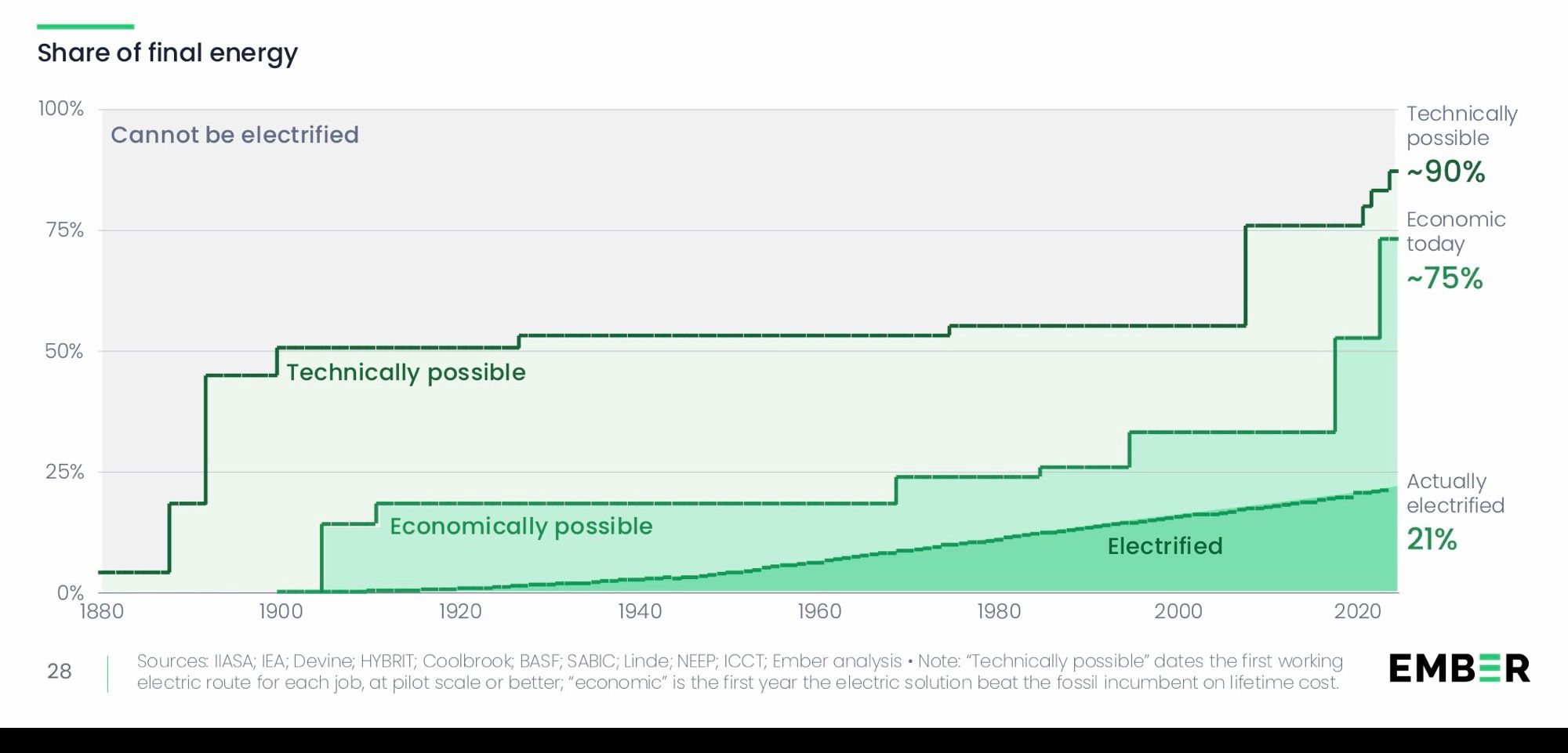
Ember’s analysis shows electrification began in the 1880s and electricity became the largest supplier of useful energy in 2007. Between 2018 and 2023 it accounted for 63% of the growth in global final energy demand, while fossil fuels contributed just 5%. If electricity demand keeps growing at around 3% a year, Ember expects final fossil fuel demand to start a structural decline by the end of this decade.
What changed since 2000
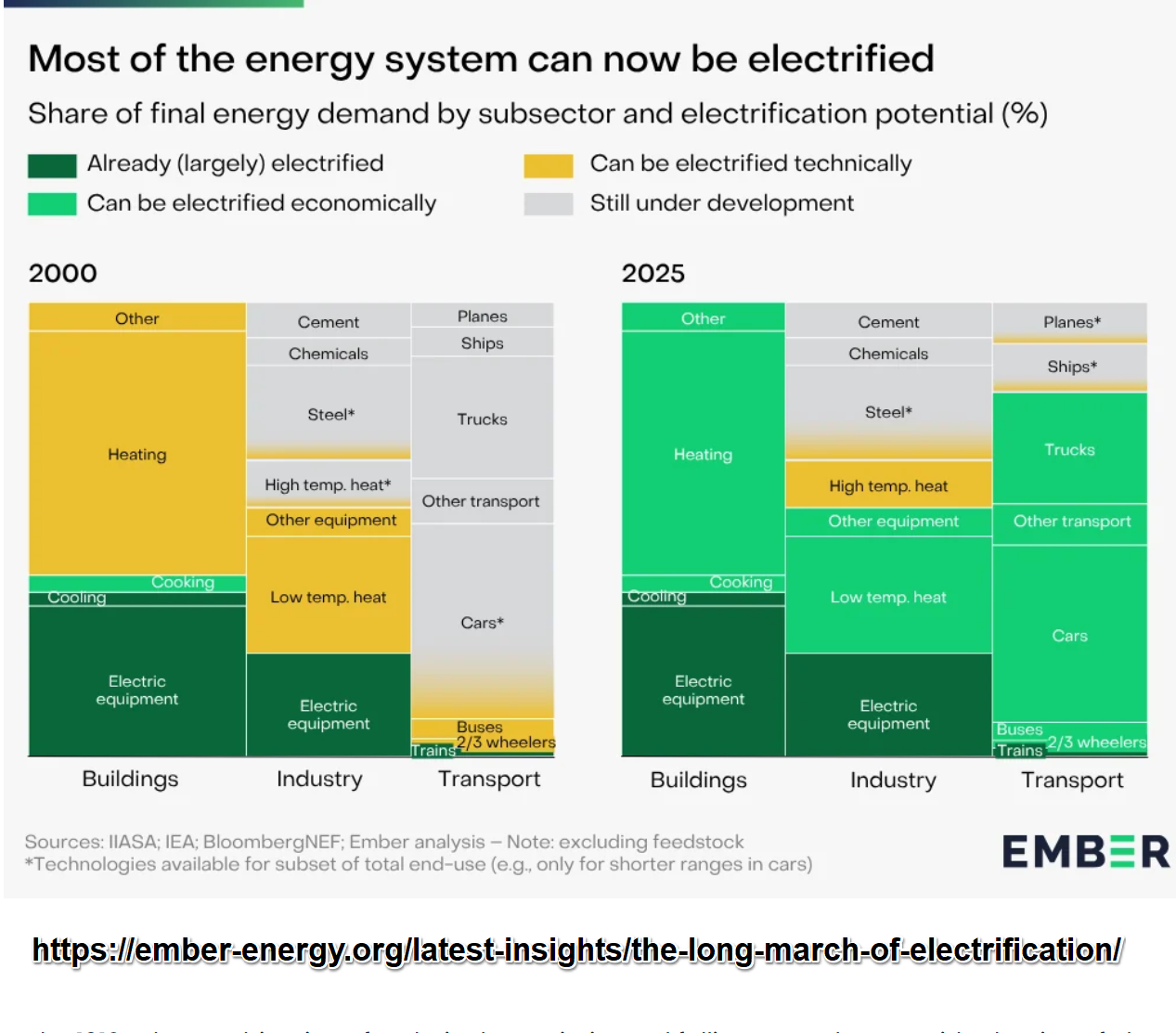
Ember reports that innovation in electric transport and heat pumps has lifted the share of global final energy demand that can be electrified from about 25% in 2000 to about 75% in 2025. Transport, roughly a fifth of global CO2 emissions, is the clearest example. More than a quarter of new cars sold worldwide in 2025 were electric, and Ember describes EVs as increasingly cost-competitive with petrol cars. Electrification can now be done economically, not just hopefully.
Ember’s long-run chart shows the gap that matters. Around 90% of final energy can technically be electrified and about 75% is economic today, yet only about 21% is actually electrified. That gap is the opportunity.
Efficiency is the hidden prize
A petrol or diesel engine wastes around 80% of the energy in its fuel. An EV uses close to 80% of the electricity it draws. Heat pumps tell the same story: UK in-situ studies found air-source units averaging about 265% efficiency and ground-source about 324%, against roughly 82.5% for gas boilers. That is three to four times more efficient. Across the whole system, Ember puts electrotech (renewables, EVs, heat pumps, batteries) at around three times more efficient than fossil systems, so each unit of new electricity can displace two to three units of fossil energy.
This is why an EV cuts fossil fuel use even on a grid that is not yet clean, and why electrification and clean generation reinforce each other rather than compete.
Clean generation caught up in 2025
Ember’s Global Electricity Review 2026 found that in 2025 clean power grew by 887 TWh, more than the 849 TWh rise in electricity demand, so fossil generation fell slightly (by 0.2%) for the first time since 2020. Solar alone met 75% of the demand growth. Renewables supplied 33.8% of global electricity against 33.0% for coal, the first time renewables have overtaken coal in the modern era. Battery costs fell 20% in 2024 and a further 45% in 2025, which is turning daytime solar into anytime solar.
Better magnets, better motors
Efficient motors are the quiet hero of electrification. Permanent-magnet synchronous motors are the most efficient electric motors, and the neodymium-iron-boron magnet inside them is the reason. Magnet makers such as TDK report that stronger, better-engineered neodymium magnets let designers build motors that are smaller, lighter and more efficient, and in 2012 TDK released the first neodymium magnet needing no dysprosium, one of the scarcest rare earths. Techniques such as grain-boundary diffusion place dysprosium only where it is needed, which one industry report says can cut heavy rare earth use by up to 70%. Permanent-magnet motors have held more than 75% of the EV motor market since 2015. Our earlier post on rare earth elements covers the supply side.
Batteries, solar and wind keep getting cheaper
Ember estimates that electrotech costs fall by around 20% every time deployment doubles, and notes that 91% of newly commissioned wind and solar facilities worldwide are cheaper than the cheapest fossil fuel option. Higher efficiency and longer working lives mean each panel, turbine and battery delivers more kilowatt-hours over its life, which pushes the cost of renewable energy down further. For the battery side of the story, see Building a Battery Future.
What about steel?
Steel is responsible for roughly 7 to 9% of global greenhouse gas emissions. It is harder than cars, but the path also runs through electricity. Electric arc furnaces melting scrap cut emissions by an estimated 75 to 80% compared with blast furnaces, and making new steel from ore is moving towards hydrogen-based direct reduction feeding electric arc furnaces.
COP31 has put a number on it
COP31 opened on 9 November 2026 in Antalya, Türkiye. COP31 President Murat Kurum pointed to the 35-by-35 Global Electrification Pledge, which aims to lift electricity’s share of final energy consumption to 35% by 2035. Chris Bowen of Australia, President of Negotiations, noted that electricity supplies only about a fifth of global final energy today and that the shift needs to be from a fifth to a third. UN Climate Change’s Simon Stiell said action on methane and electrification together could cut about half a degree from projected warming, and that 90% of large renewable projects are now cheaper than fossil alternatives.
Set that beside Ember’s chart: about 21% of final energy is electrified today, and about 75% is already economic to electrify. A target of 35% by 2035 is a start, not a stretch.
The 80/20 argument
What follows is my argument, not Ember’s or the IMF’s. The Pareto principle suggests the easy 80% of the job (road transport, heating, hot water, cooking and the power station itself) can be done today with technology that already pays its way. Steel, cement, aviation and shipping can follow.
The money is there. The IMF’s December 2025 update estimates that in 2024 fossil fuels received $725 billion in explicit subsidies (0.6% of global GDP) and $6.7 trillion in implicit subsidies, mostly unpriced air pollution and climate damage (5.8% of GDP). Together that is about $7.4 trillion, or 6.4% of world GDP. Only the $725 billion is money governments actually spend; the rest is the cost of damage that fuel prices do not cover. Separately, Ember calculates that fossil fuel importing countries spent $1.7 trillion on imports in 2024, and that replacing imported fuels in transport, heating and power with EVs, heat pumps and renewables would cut those imports by 70% and save about $1.3 trillion a year. EVs alone account for about $590 billion of that saving.
My claim is that if those subsidies were redirected to electrification and clean energy, a target of 80% electrification by 2035 would be achievable, far exceeding the 35% proposed at COP31. For scale, Ember’s chart puts about 75% as economic to electrify today and about 90% as technically possible. On emissions, the IMF’s modelling of pricing reform alone is more cautious: removing explicit subsidies would cut CO2 by 6% below baseline in 2035, and correcting both explicit and implicit subsidies through taxes would cut it by 46%, though the IMF notes that is politically difficult.
So it is not electrification versus clean electricity. Electrification delivers the efficiency, clean generation delivers the clean electrons, and falling costs are making both the economical choice. For more, see Rebutting the Anti-Electrification Playbook and Electrify Everything.
References
- Ember, The long march of electrification (July 2025)
- Ember, Global Electricity Review 2026 (April 2026)
- Ember, The Electrotech Revolution (September 2025)
- Ember, The EV leapfrog (December 2025)
- Ember, The energy security fallout (March 2026)
- Ember, Energy Security in an Insecure World (April 2025)
- Ember, China Energy Transition Review 2025
- IMF, Underpriced and Overused: Fossil Fuel Subsidies Data 2025 Update (Working Paper 2025/270, December 2025)
- UN Climate Change, “COP31 must supercharge solutions”: opening day statements (9 November 2026)
- World Economic Forum, Cars, planes, trains: where do transport CO2 emissions come from?
- Energy Voice, Heat pumps at least three times more efficient than gas boilers
- TDK, Magnet solutions that improve the efficiency of drive motors for EVs
- IDTechEx, Magnetic Materials That Could Replace Rare Earths in EV Motors
- World Economic Forum, Steel industry makes pivotal shift towards lower-carbon production
- Climate Solutions News, Steel industry’s shift towards reducing carbon emissions
