
Electrons Not Molecules: the warm-up act
Electrons grow a little more every day as solar scales. Molecules, the fuels we dig and drill, hold steady or fall out of fashion. This week’s episode of The Angry Clean Energy Guy puts a number on that gap, and it should make every gas lobbyist spill their coffee.
Assaad Razzouk’s argument is simple. Everyone is panicking that AI data centres are breaking the grid. The demand is real. But data centres are only the opening act. The main event is physical AI: intelligence moving out of server rooms and into trucks, tractors, factory robots and humanoids.
His tagline for the episode: wires eating pipelines. His other one: thinking is cheap, moving atoms is not.
The numbers behind the argument
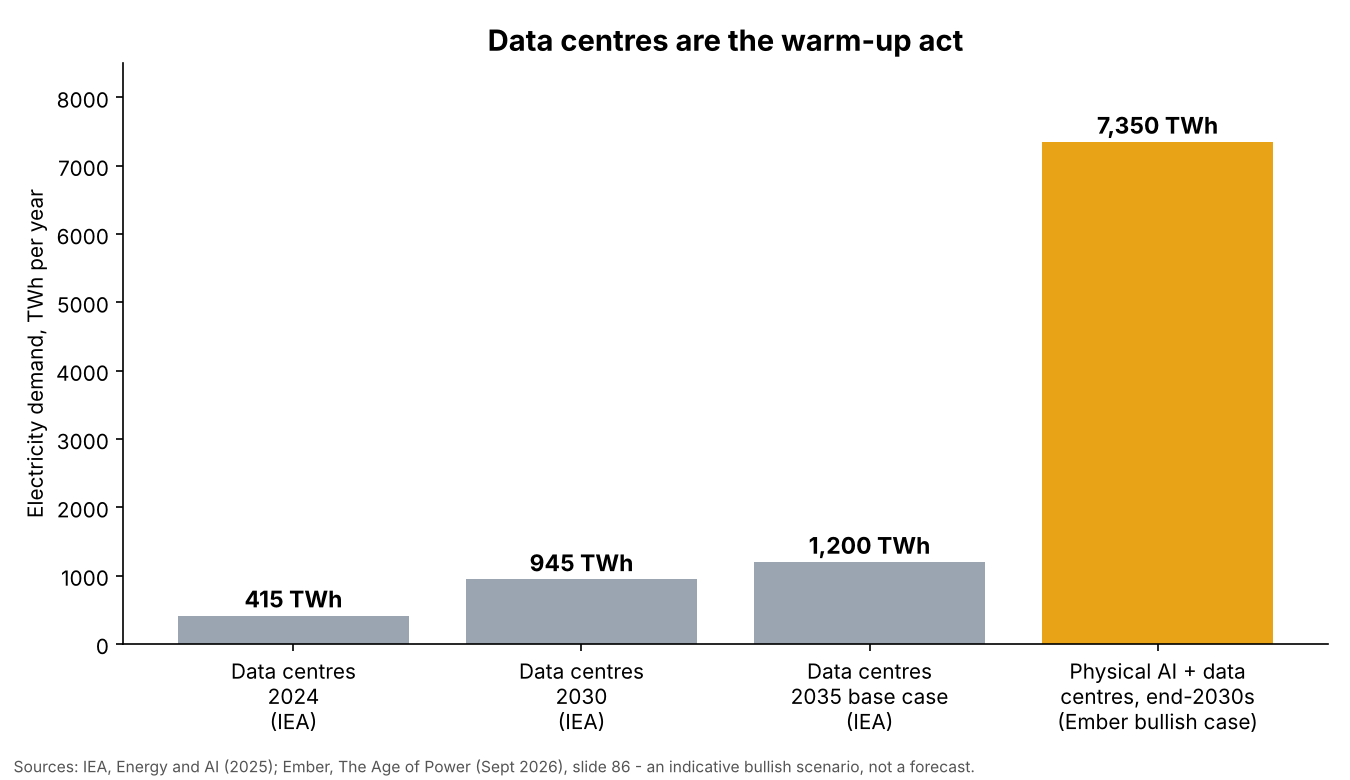
Data centres (IEA). The IEA puts data centre electricity use at around 415 TWh in 2024, about 1.5% of the world’s electricity. It sees this more than doubling to around 945 TWh by 2030 and about 1,200 TWh by 2035 in its Base Case. Its 2026 update has data centres roughly doubling from 485 TWh in 2025 to about 950 TWh in 2030, around 3% of global demand.
Physical AI (Ember). Ember’s The Age of Power (September 2026) models an “indicative bullish case” for the end of the 2030s: lights-out electrified factories (a tenth of factory fuel plus 23 million robot arms), driverless electric trucking (a third of truck travel), robotaxis (a third of car travel), and 100 million humanoid robots. Physical AI plus data centres comes to about 7,350 TWh a year. Razzouk reads the physical AI share as about 6,200 TWh, roughly five times the IEA data centre case.
Why it replaces oil. Razzouk notes combustion engines turn about 20-30% of fuel into motion. Electric motors turn about 90% of electricity into motion. Ember adds that the combined cost of the electric stack (chips, sensors, power electronics, batteries, motors) has fallen 99% since 1990. Together with automation it sees running costs falling up to 80% for households, up to 70% for freight and taxis, and 40-70% for manufacturing.
Why gas can’t keep up
Razzouk is blunt here. The people saying “we need gas for AI” have the maths backwards. His figures, which are his own and not from the IEA or Ember:
- The world builds about 70 GW of heavy gas turbines a year, mostly from three companies, and they are sold out with waits of five to seven years.
- Nuclear takes 15-20 years to permit and build.
- The world makes more than 1,300 GW of solar a year, about 20 times the turbine number, and batteries arrive in 6-12 months.
A fully automated economy running on imported fuel is an economy that has, in his words, automated its own hostage situation. Singapore runs about 95% on imported gas, so nobody there needed the Strait of Hormuz closure explained.
Transport: the wires are already winning
Cars. The IEA’s Global EV Outlook 2026 says electric vehicles are on track to reach around 50% of global car sales by 2035, with the share of internal combustion cars shrinking in every scenario it models. Australia is moving: EVs hit a record 16.4% of new car sales in April 2026, up from about 1% in 2020.
The bullish case for Australia. Professor Ray Wills of Future Smart Strategies has modelled Australian sales out to 2030. His projection has petrol and diesel (ICE) car sales falling from about 840,000 in 2025 to close to zero by 2030. Battery EVs rise from just over 100,000 in 2025 to around 1.2 million, crossing ICE sales in about 2028. Hybrids peak at around 200,000 and then fade.
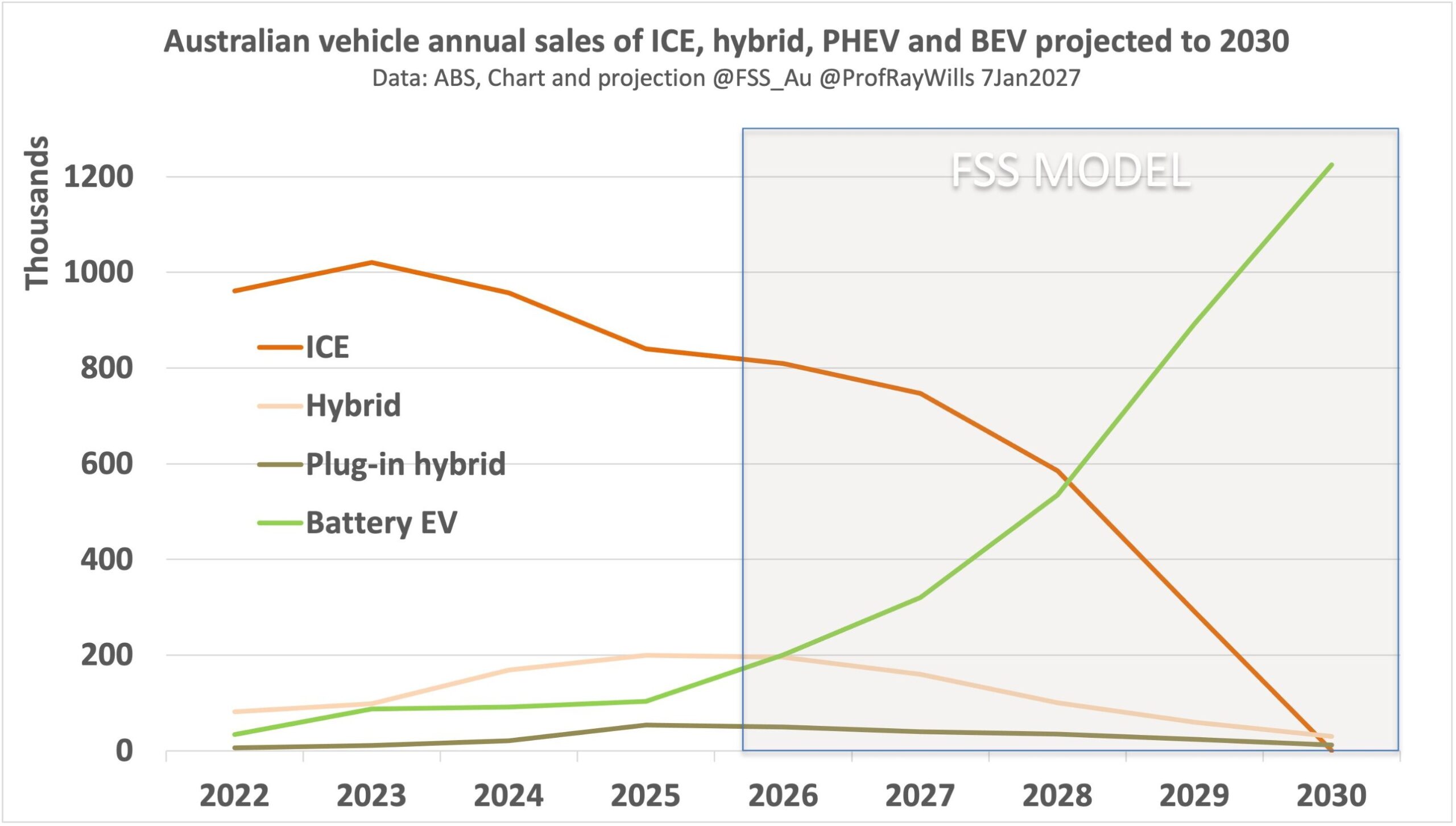
Treat it as the optimistic end of the range. Wills has made bold calls before: in 2019 he predicted only EVs would be sold in Australia from 2026, and the market is not there yet. But the direction of travel is the point. Where is the next ICE car buyer coming from, when the electric one is cheaper to run?
Trucks. China is showing the way. Electric trucks made up 50.3% of all heavy trucks sold in China in September 2026, about 33,100 electric big rigs in one month. For the first nine months of 2026 the share is 38.1%, up from 28.9% in 2025. Beijing’s own target is 40% of new heavy truck sales by 2030, so the market is running well ahead of the plan.
Mining. Fortescue has pledged to eliminate fossil fuels from its Australian iron ore operations by 2030, switching off diesel and gas. That means getting off the roughly 630 million litres of diesel it burns a year in trucks, diggers and other mining equipment. The plan costs an estimated $6.2 billion, and Fortescue expects savings of $818 million a year from 2030. It is building a Pilbara green grid of 1.2 GW of solar, more than 600 MW of wind and 4-5 GWh of batteries, now due by the end of 2028.
The pattern is the same everywhere: where the wires arrive first, the diesel stops.
The China exception
Ember calls China the standout. Since 2010 it has more than doubled its electricity supply, taken EVs from zero to over 60% of new car sales, and built the world’s largest robot fleet and second-largest AI data centre fleet. Razzouk’s point: that “electro-shield” is why China could cut oil imports when Hormuz closed.
What this means for Ada and Tracey
Ada is one of the 655 million people who still have no electricity, and one of the two billion who cook on polluting fuels. Like many of them, she can spend over 40% of her day getting energy and water: collecting fuel, carrying water, tending a smoky fire.
Energy freedom gives Ada back her time and her security. She gains four or five hours a day. She has clean water, smoke-free cooking, and children who no longer fall sick from waterborne disease. No pipeline will ever reach her village. A panel, a battery and a wire can.
Tracey lives in Australia, where her energy bill is now the third or fourth biggest cost in the household after rent and transport. Her prices have doubled in five years. Her family doesn’t turn the heating on in winter, and in summer the house overheats. Climate change will make that worse.
An electrified household is different. Electrify Australia puts the saving at around $5,000 a year for a home that switches to solar, efficient electric appliances and an electric car. On an after-tax income of about $70,000, that is a boost of roughly 7% to real living standards. Over the past year wages rose 3.5% while prices rose 4.9%, and real wages remain roughly 6% below their 2020 peak.
Ada gains time. Tracey gains money. Both gain security. Neither needs a pipeline.
The takeaway
Solar is eating gas, batteries are eating the night, EVs are eating oil, and physical AI is coming for whatever is left. You can’t blockade the sun or sanction the wind.
Next time someone tries to scare you with data centres eating the grid, ask them to check their maths. Then remind them: wires are eating pipelines.
More reading
- IEA, Energy and AI (2025): iea.org/reports/energy-and-ai
- IEA, Key Questions on Energy and AI (2026): iea.org/reports/key-questions-on-energy-and-ai
- Ember, The Age of Power (16 Sep 2026): ember-energy.org
- Ember, The Age of Power slide deck (physical AI scenario on slide 86): slide deck (PDF)
- IEA, Global EV Outlook 2026 (coverage with Australian sales data): AAP via CommBank
- IEA, World Bank, WHO and partners, Tracking SDG7 (655 million without electricity, 2 billion without clean cooking): iea.org
- RenewEconomy, Electrify Australia: electrifying homes and cars can save $5,000 a year: reneweconomy.com.au
- Rewiring Australia, Castles and Cars (average household saves $5,443 a year): inkl.com
- Prof Ray Wills (Future Smart Strategies), Australian sales projection to 2030, used with permission. Original post: x.com/ProfRayWills. Follow him on X: @ProfRayWills and @FSS_Au
- Wills and Newman, Victorian parliamentary EV inquiry presentation (BEV sales passed 100,000 in 2025): parliament.vic.gov.au
- Electrek, electric trucks hit 50% of China’s heavy truck sales: electrek.co
- Fortescue, eliminating emissions: metals.fortescue.com
- Mining.com, Fortescue’s Pilbara green grid: mining.com
- The Angry Clean Energy Guy, Episode 105 (Assaad Razzouk): theangrycleanenergyguy.com
