
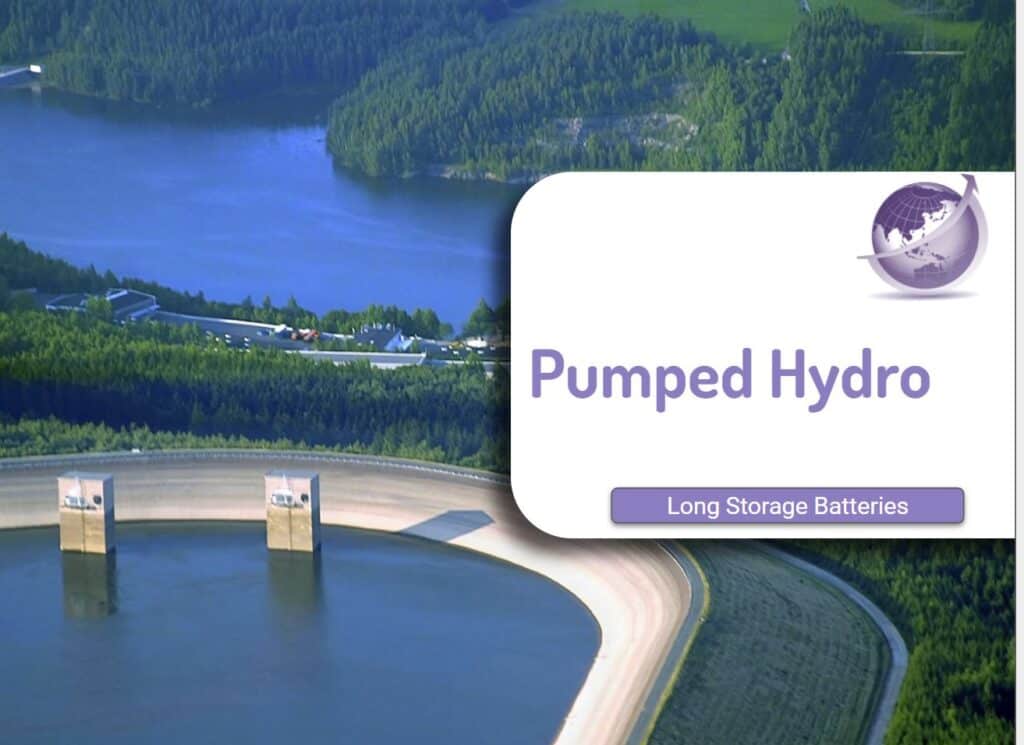
Pumped Hydro as a Battery
Hydro power is about 10% of the global energy production, but pumped hydro is being pursued as part of the solution for intermittent storage in renewable energy
Batteries are the standout technology enabling the build-out of renewable energy. They do not make electricity, but when paired with solar and wind they free us from wires and fuel, and they are moving from powering our devices to powering vehicles, homes and entire grids. Costs have fallen about 97% over the past 20 years, following Wright’s Law, where each doubling of production cuts cost by up to 15%.
Our posts follow the technology on every front: lithium-ion improvements, silicon anodes, sodium-ion cells launched in China, solid state announcements and the long record of Toyota’s solid state delays, plus iron-air, liquid metal, flow, nickel-hydrogen and even gravity and compressed air storage. Others cover 15-minute charging, million-kilometre and 1000-mile batteries, and research suggesting batteries can last 40 years.
The bigger story is what batteries do to the grid. Posts show grid-scale and home batteries growing rapidly, community batteries on power poles, and how storage turns electricity from baseload into dispatchable power. A recent post explains how more storage, held back for the worst moments, could cut wholesale electricity costs by 20%. Pumped hydro and Queensland proposals are covered too. Start here to see why batteries are ending the fossil fuel era in transport and power.
Hydro power is about 10% of the global energy production, but pumped hydro is being pursued as part of the solution for intermittent storage in renewable energy

What is the real figure of amount of lithium in a battery. The quantity of 6kg is elemental lithium. The quanty of Lithium carbonate equivalalent or LCE is used in mining circles and the quantity is about 60 kg. A large opportunity for efficiency improvement is clear.

Home and community battery is a smart way to reduce transmission costs and to improve reliablity of renewable energy. Losses in transmission are about 10% and batteries cost much the same whether close to consumers or at a solar farm.

While lithium ion batteries are the mostly widely used, other battery technologies are avalable that are competitive in some applications. Numerous other battery chemistries are in R&D phase