Most of what we pay for wholesale electricity is set on ordinary days. But a surprising share is set in a few hours of extreme prices, and batteries are the obvious tool to flatten them.
Two days in South Australia
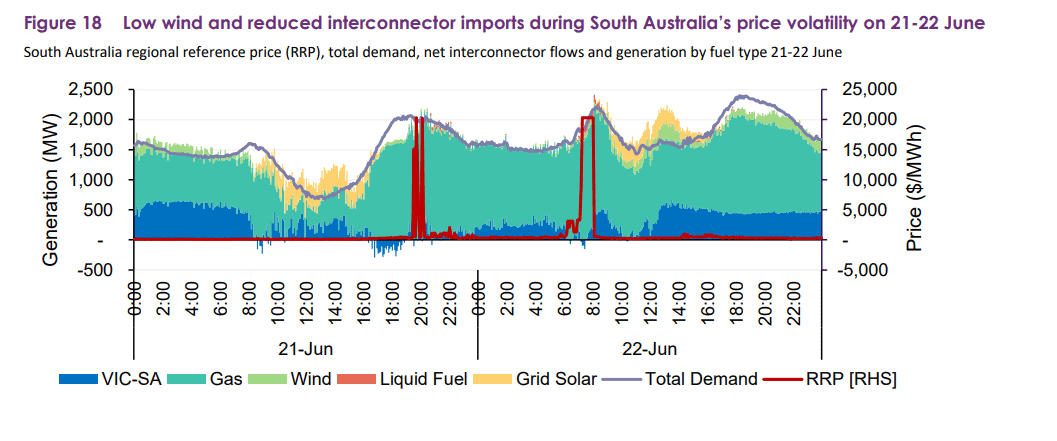
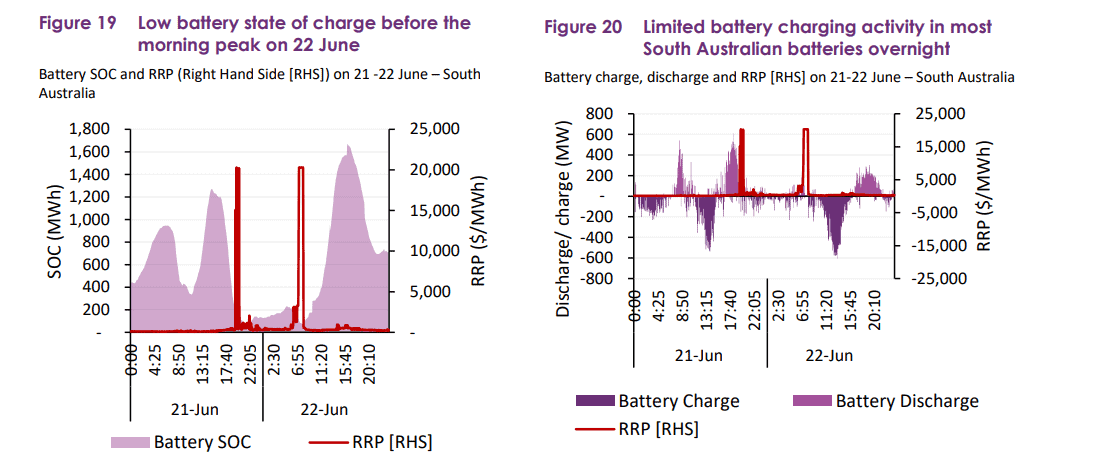
AEMO’s Quarterly Energy Dynamics report for April to June 2026 found that South Australia was the only region with any material price volatility. On 21 and 22 June, cold and still weather pushed demand above 2,000 MW while a three-day wind lull cut output and transmission constraints limited imports. The region leaned on gas.
Prices passed $10,000/MWh for four intervals on the evening of 21 June. On the morning of 22 June they exceeded $1,000/MWh for 22 five-minute intervals, ten of them at the $20,300/MWh market price cap. Those two days added $13/MWh to a quarterly average of $86/MWh, about 15 per cent of the total.
Why the batteries could not help
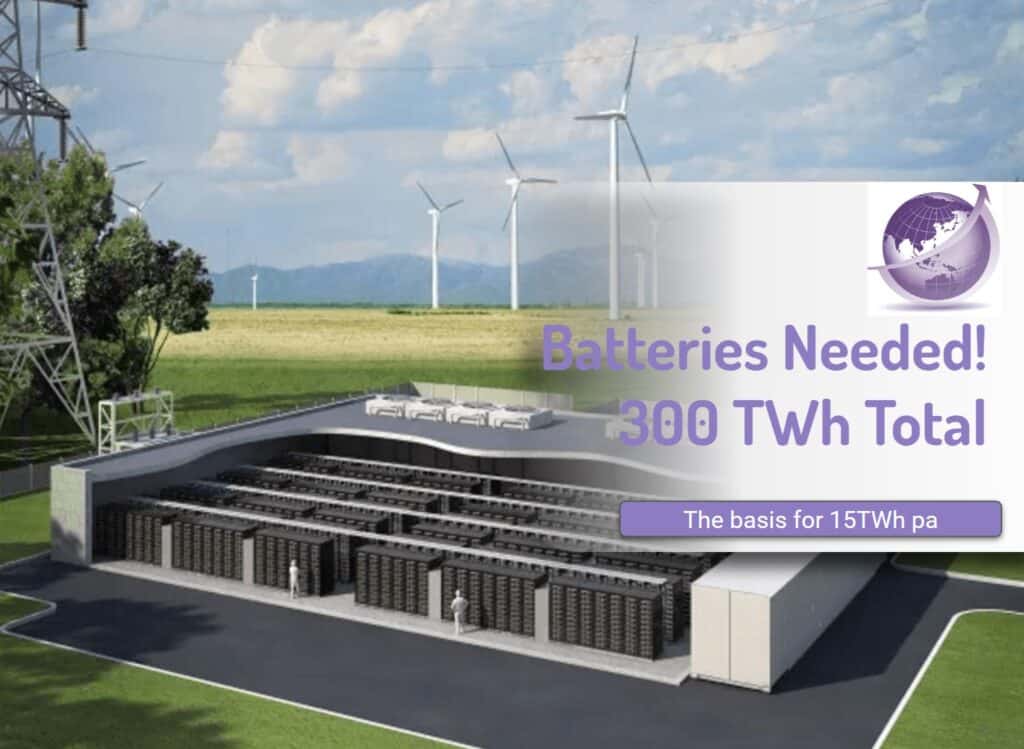
The cause was not too many batteries but too little stored energy. Through the evening peak the state’s batteries discharged almost everything, falling to around 10 per cent of capacity just as prices spiked. Overnight prices stayed so high that most did not recharge, so they entered the morning peak nearly empty.
The 20 per cent argument
Renew Economy columnist David Leitch argues that 20 to 30 per cent of the power component of a bill comes from well under 1 per cent of hours, when prices exceed $1,000/MWh. That is his estimate, made on the Energy Insiders podcast in July 2025, and I have not been able to confirm it against AEMO’s data, so treat it as a working figure. The June event is consistent with the direction: 15 per cent of South Australia’s quarterly price came from two days, and in the January to March quarter, a two-day heatwave added $63/MWh to a $144/MWh average, about 44 per cent.
His remedy is large reserve batteries, owned by governments or networks, that sit idle and discharge only when prices are very high. Cutting those few hours would do more for consumers than most other measures. Leitch opposes state-owned generators and says high prices send a useful signal for investment, so the two views sit in some tension. Either way, batteries with more hours of storage are the clear gap this event exposed.
A note from Leitch’s own website. His ITK Services site gives a similar but more modest figure. An entry dated 8 February (2026), on New South Wales prices, says “about 20% of the average annual price comes from spikes that occurred in only 0.3% of the half hours”. That is roughly 26 hours a year, fewer than the 40 to 90 hours he mentioned on the podcast, and the bottom of his 20 to 30 per cent range, though for one state rather than South Australia. A 3 July entry on South Australia’s spikes says the battery trading algorithms were “not very smart refusing to recharge at $300 overnight”, which matches AEMO’s account of the June event. I found nothing on his site about the $500 million or the six-times battery return.
Changes in prices by fuel type
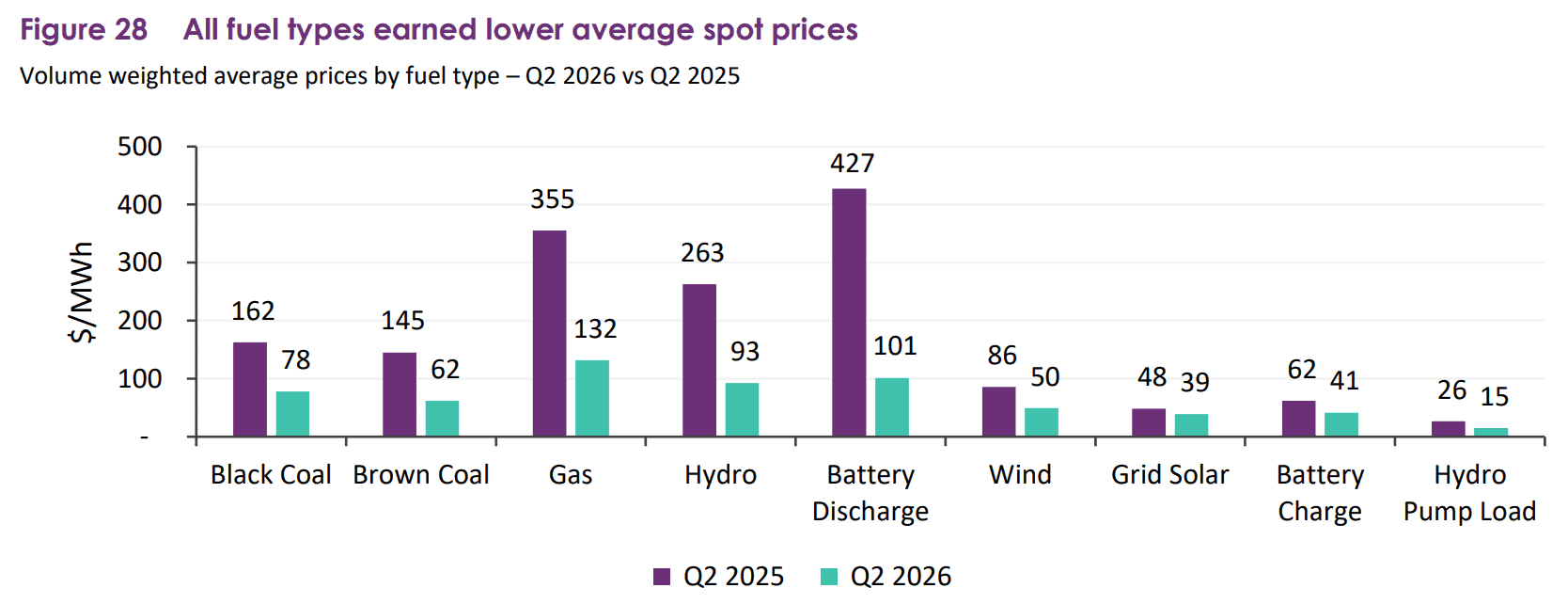
Figure 28 shows the average spot prices earned or incurred by different fuel types across the NEM, derived as volume-weighted averages based on their generation or load volumes in each dispatch interval. In Q2 2026, volume-weighted average prices declined for all fuel types compared to Q2 2025.
AEMO, Quarterly Energy Dynamics Q2 2026, section 2.2.5
Where the retail price goes
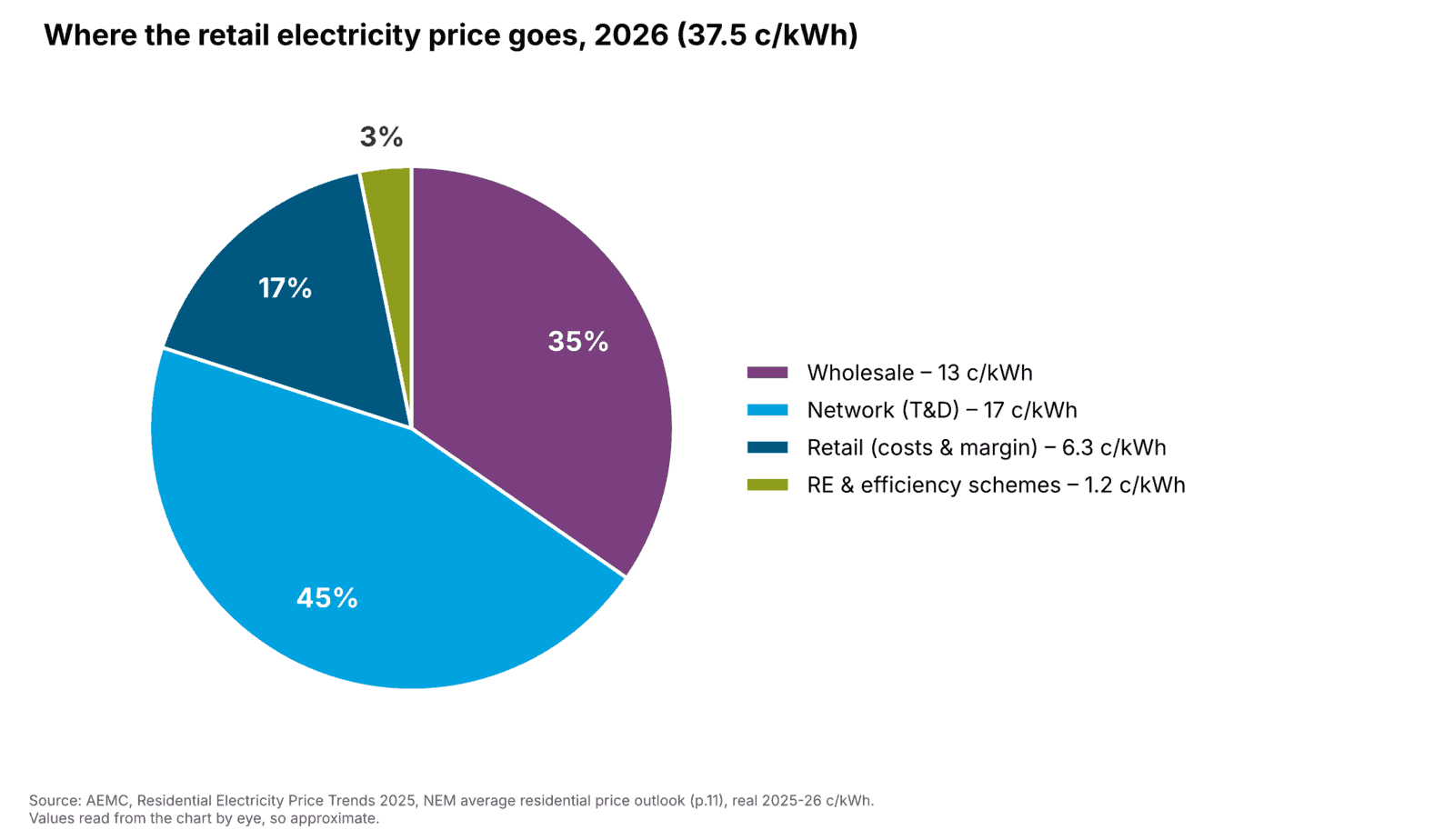
Wholesale spikes matter, but they are only one slice of the bill. The AEMC’s 2025 price outlook puts the average 2026 residential price at about 37.5 c/kWh. Network costs (transmission and distribution) are the largest part at about 45 per cent, wholesale is about 35 per cent, retail costs and margin about 17 per cent, and renewable and energy efficiency schemes about 3 per cent. Cutting price spikes helps the wholesale slice, but network costs are the larger target, and the AER found they mostly rose again in 2026-27.
Are we paying $10 billion too much?
Australia’s poles and wires were built with public money, and several states have since sold or leased their network businesses to private owners. The Institute for Energy Economics and Financial Analysis (IEEFA) estimates that network companies in eastern Australia earned about $10 billion in supernormal profits between 2014 and 2021, adding an average of 6.8 per cent to bills in 2020. IEEFA puts the cause down to regulators overestimating the costs networks needed. Whether privatisation is behind that overcharging is a separate argument, and one for another day.
What David Leitch said
In the Energy Insiders podcast of 28 July 2025, Renew Economy columnist David Leitch made these points:
- Cost driver: roughly 20 to 30 per cent of the power component of bills comes from fewer than 1 per cent of hours, around 40 to 90 hours a year when prices exceed $1,000/MWh.
- Proposal: reserve batteries owned by governments or networks, idle except when prices are very high. A state-owned retailer such as Victoria’s could invest in them.
- Peaks: he expected AEMO’s next Quarterly Energy Dynamics report to show pumped hydro, gas and also battery storage driving some price peaks.
- High prices as a signal: the market price cap has been raised again, and he sees high prices as the signal investors need.
- South Australia: in the previous 12 months, generators that could supply during about 90 hours above $1,000 earned around $500 million. He estimated a battery covering all those hours could have earned about six times what was needed to justify the investment.
- What the signal does: it invites more supply, demand response and competition at the thin, volatile peak of the market.
- State ownership: he does not want state-owned generators, and acknowledged he is probably in a minority among the show’s audience.
References
- IEEFA, Energy consumers paid $10 billion too much for electricity (5 October 2022), based on Simon Orme, Regulated Electricity Network Prices Are Higher than Necessary
- AEMC, Residential Electricity Price Trends 2025
- AER, Default Market Offer 2026-27 final determination (May 2026)
- Renew Economy, Energy Insiders Podcast: Greasing the wheels of net zero (28 July 2025)
- AEMO, Quarterly Energy Dynamics Q2 2026 (28 July 2026)
- RenewEconomy, Depleted batteries and very expensive gas: how a two-day heatwave caused near doubling of quarterly prices
- AEMC, Market price cap for 2026-27
- Baringa for Energy Consumers Australia, Does the market price cap provide an effective investment signal?