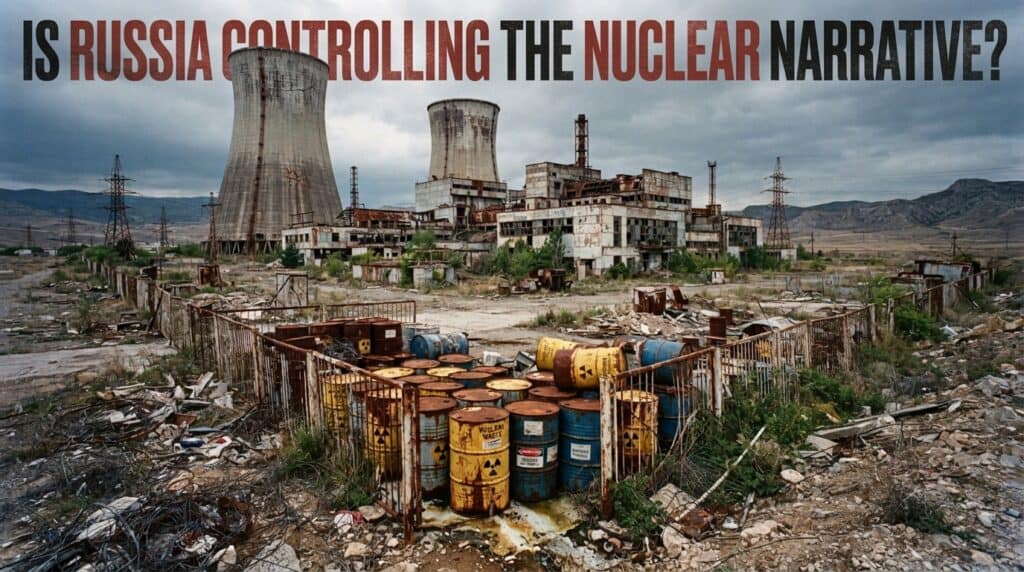
Nuclear power is sold as a Western revival. The numbers say otherwise: the new reactors are overwhelmingly Russian and Chinese designs, and the fuel supply still runs through Moscow.
What the latest status report shows
On 1 July 2026, 73 reactors were under construction worldwide. Of these, 63 are built by Chinese or Russian companies, leaving just 10 of other designs [1]. Rosatom, the Russian state corporation [1][2], is building 28, or 39 per cent of the world total. Seven are in Russia and 21 abroad, plus Slovakia’s Mochovce-4, a Russian design finished by a Czech-led consortium [1].
The 22 export projects are in China, Egypt, India and Türkiye (four each), Bangladesh (two), and Hungary, Iran, Uzbekistan and Slovakia (one each) [1]. All four countries building their first reactor (Bangladesh, Egypt, Türkiye, Uzbekistan) chose Russian builders [1][4].
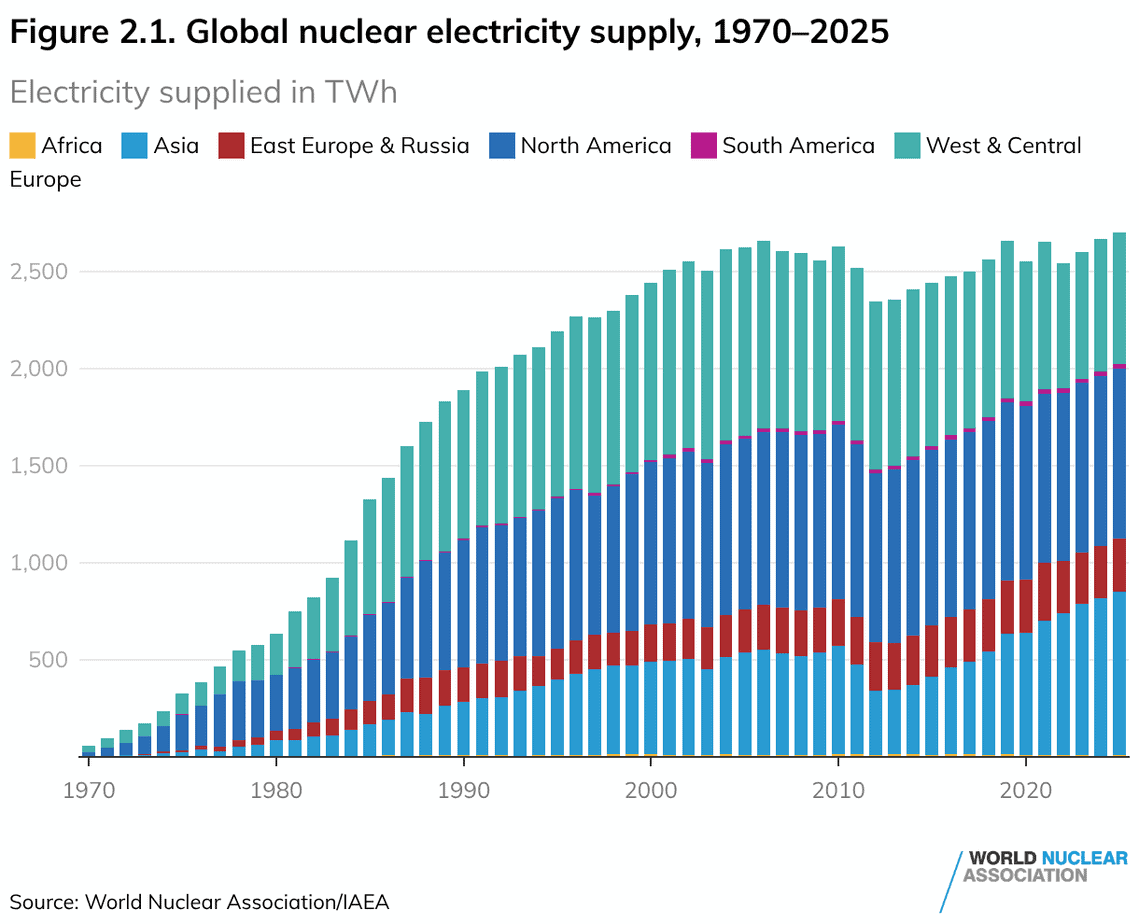
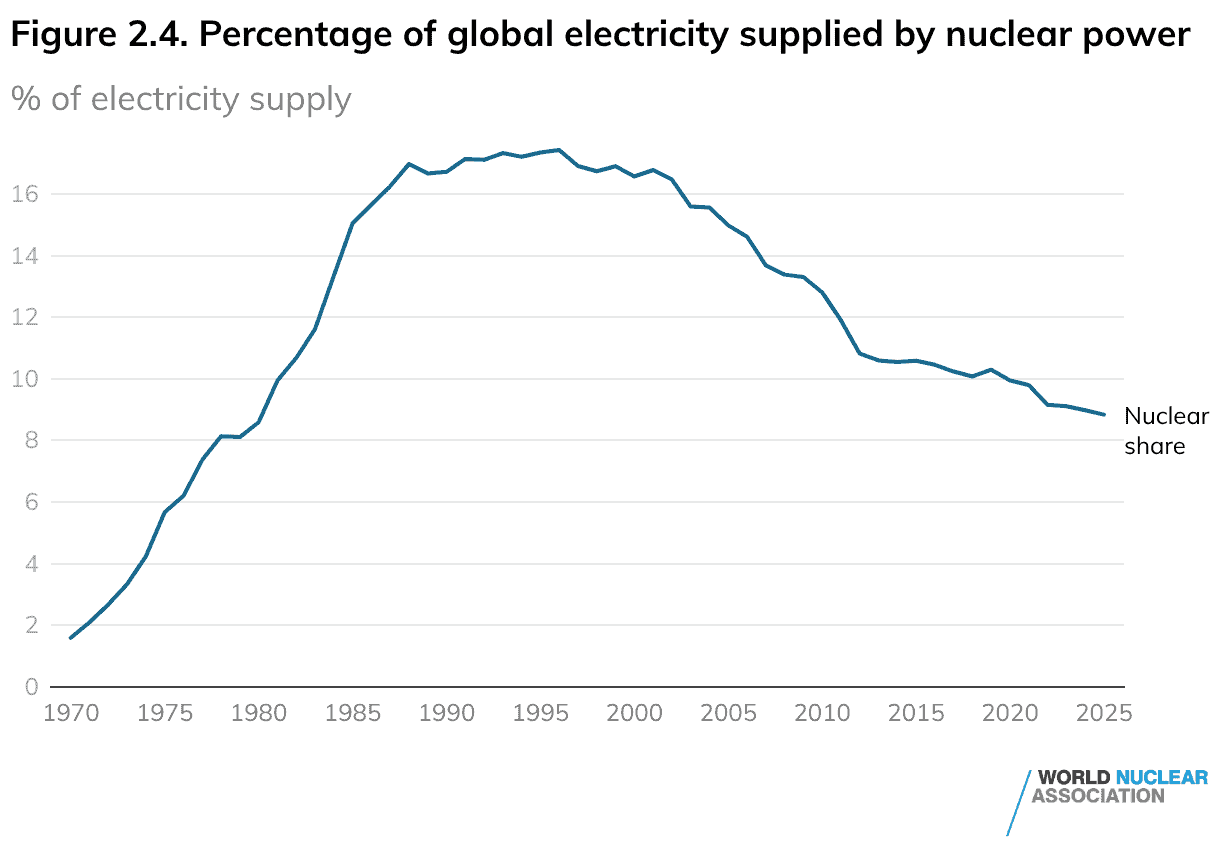
Meanwhile nuclear’s share of world electricity fell to 8.8 per cent in 2025, about half its 1996 peak, with 411 reactors operating [1].
The fuel dependency
Rosatom matters beyond construction. Russia held about 44 per cent of world enrichment capacity in 2022 [1]. In 2025 Rosatom still supplied 22.5 per cent of enrichment services to the EU, down from 31 per cent in 2021 [1]. US imports of Russian enriched uranium rose 20 per cent in 2025, making Russia America’s second-largest supplier [1]. The EU had imposed no nuclear sanctions on Russia by mid-2026 [1].
Fuel purchases and reactor contracts send money to a state at war with Ukraine.
Who is talking up nuclear online?
The 2026 status report makes a pointed observation about Japan. It describes a “widespread online dissemination of anti-science and anti-intellectual misinformation” in the energy sector, where conspiracy-minded commentators who call themselves “conservative” praise nuclear power and attack renewables “without sufficient scientific basis or data”. It concludes that Japan’s slower adoption of renewables is partly due to politicians being intimidated by such narratives [1].
That raises a question for Australia. Our Coalition took seven reactors to the 2025 election and now promises to lift the nuclear ban, and One Nation wants reactors built [4]. Nuclear is a technology with no near-term prospect here: no small modular reactor on the standard definition exists or is under construction anywhere [4]. So who is amplifying it online? Are Russian-linked bloggers and accounts, already documented running information operations about nuclear weapons and radiation in Europe [3], also pushing nuclear power in countries such as Australia, and in doing so delaying renewables? I have not found published evidence either way. It is a question that researchers and regulators should be asked to answer.
Why this matters
The economics are poor. In 2025 nuclear added 1.5 GW of capacity against 693 GW for renewables, and attracted US$35.6 billion against US$690 billion [4][5]. Reactors that began operating in 2023-2025 took 10.9 years on average to build [4]. By the time a reactor started today produced power, solar and batteries would long since have cut emissions faster and cheaper [6].
Pushing nuclear delays that transition while keeping fuel money flowing to Rosatom. The sensible response is to spend on solar, wind and storage now, and stop funding Russian enrichment [6].
References
- Schneider, M. et al. World Nuclear Industry Status Report 2026 (Executive Summary; Construction Data; Russia Focus; Russia Nuclear Interdependencies, incl. Figure 58; Japan Focus, pp. 17-18). https://www.worldnuclearreport.org/IMG/pdf/wnisr2026-v1.pdf
- Rosatom, Wikipedia (state corporation; owner listed as Russian government). https://en.wikipedia.org/wiki/Rosatom
- Lander Finch, N. and Arick, R. How the US and Europe can counter Russian information manipulation about nonproliferation. Atlantic Council, 4 October 2024. https://www.atlanticcouncil.org/in-depth-research-reports/issue-brief/how-the-us-and-europe-can-counter-russian-information-manipulation-about-nonproliferation/
- Optimistic Storm, “Nuclear Update 2026 – Still Moribund”, 4 October 2026. https://optimisticstorm.com/nuclear-update-2026-still-moribund/
- Green, J. “Nuclear power’s quarter-century of stagnation has no end in sight, and has been overtaken by solar PV”. RenewEconomy, 1 October 2026. https://reneweconomy.com.au/nuclear-powers-quarter-century-of-stagnation-has-no-end-in-sight-and-has-been-overtaken-by-solar-pv/
- Butler, H. Optimistic Storm Part 3: Nuclear and Hydrogen (author’s analysis; cites Lazard cost comparisons). https://www.amazon.com.au/dp/B0DTJ354R2