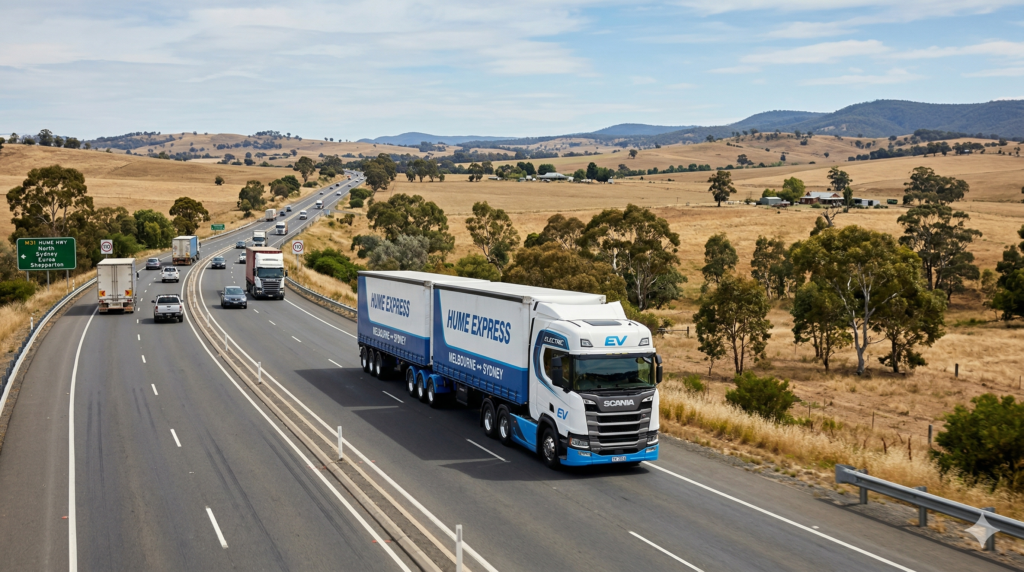
Electric trucking in Australia is well overdue for a radical change, and the Middle Eastern conflict (2026) makes this a priority. Over 20 million tonnes of freight are moved from Sydney to Melbourne each year, with over 1.2 billion truck kilometres. Between 4,000 to 6,000 heavy trucks are on the Hume Highway each day. Trucks cost about $200,000 per year in diesel, or about $1 per km. In contrast, an electric B-Double prime mover uses about 1.25 to 2kWh per km, depending on load from 40 to 60t. At 15c/kWh for electricity, the cost of an EV truck is about 30 cents per km – a third of diesel.
The cost of diesel used in this sector is over $1.2 billion – mostly sent overseas. In contrast, the electricity used will be sourced locally and remain within the Australian economy. The capital cost of an electric prime mover is about $500,000 versus about $280,000 and will require appropriate charging infrastructure.
New Energy Transport
Daniel Bleakley from New Energy Transport, previously head reporter in The Driven, is planning to build a hub at Wilton on the Sydney Woollongong Canberra operating loop. It is a 480km round trip with 36 tonne load using Windrose trucks. They have a business model based on the complete outsourcing of trucking operations. They are designing from first principles for transport. They intend to :
- Site. Own or lease the site.
- Electricity. Own or lease. 10 MW battery with a 5MW connection. Takes 1 hour to charge a truck with megawatt charging using MCS megawatt charging standard.
- Own or lease the trucks.
- Start with 20 trucks, scaling up to 200 trucks.
- First-application principles can provide a low-carbon solution to the Sydney-to-Canberra link and, eventually, Sydney-to-Melbourne.
- They are working on first principles as trying to retrofit electricity, charging bays would be limited in existing truck stops.
The target is to reduce freight costs by 20%. Various players will pick up some of the margin.
Battery on Wheels
Each truck (Windrose, Tesla, Scania, Mac) have 500 to 750 kWh of batteries, which for a fleet of 100 trucks, is over 60MWh of batteries – or the size of the first “big battery” in South Australia. For the past 100 years, the trucking and the electricity sectors have been completely separate. Now they will be combined.
Bring On Autonomous Vehicles
The fuel cost is 27%. Labour costs of operation is over 40% in 2021, and is unlikely to have changed with increase in wages. There are about 250,000 truck drivers, of all truck sizes. There is a driver shortage of about 28,000. The six-wheeler truck fleet may have about 80,000 drivers and to put it into context is twice the number employed in mining. Will trucks be autonomous or will the upcoming deployment of humanoid robots be sufficiently expert to drive trucks?
Other Benefits of Electric Trucking in Australia
Transport is the 2nd biggest source of emissions – 20% of Australians, and Australia has the second highest road transport distribution networks in the world, behind USA. It has one of the longest food chains based on diesel. From farm to distribution centers and back out to the supermarkets – Coles and Woolworths. The industry is very exposed to global disruption of fuel supplies.
- Diesel trucks will slow down by 10% to save diesel, but incur additional wages
- Trucks can maintain legal speed up and down hills
- Driver experience, health benefits and broader community impacts
- Older diesel trucks get deployed into cities, incurring more pollution, and associated health issues.
A million trucks in China are now electric, and most buses and sales have increased to over 40% during 2025.
References
- David Leitch. 2026 Prioritising the Diesel Replacement Opportunities https://itkservices3.com/posts/diesel_to_electricity
- The revolution in electric trucking | Energy Insiders https://reneweconomy.com.au/video-the-revolution-in-electric-trucking-energy-insiders/
- Fuel and Labour Truck Costs in Australia. 2024 https://optimisticstorm.com/fuel-and-labour-truck-costs-in-australia/
- Rabot and Staheli 2021 Heavy Vehicle Operating Cost Model Update Note https://optimisticstorm.com/wp-content/uploads/2025/06/Heavy-vehicle-operating-cost-model-update-note-for-consultation-purposes-only.pdf